|
🗓️
(Marketing Analysis) How I Would Use Email Marketing to Drive Framework's Goal of Fixing Consumer Electronics
Email is a great opportunity for getting information directly to your audience since it isn't controlled by an algorithm like social media, and your audience is more likely to actually encounter what you've sent them compared to a blog post. In this article I analyze how you can make use of that opportunity, using the brand Framework as a case-study
If you don't know Framework, you should look them up right now. They build laptops(and desktops) you can actually repair, upgrade, and customize, so you're not forced to replace your device every few years just because a manufacturer decided so. Their mission is to remake consumer electronics in a way that respects both people and the planet, and unlike most companies that say things like that, they mean it.
I've been on their newsletter for a while now, and what strikes me most about their emails is how honest they are. They'll tell you prices are going up and explain exactly why: supply crunch, silicon demand outpacing production, costs passed from suppliers. They closed their year-end email with "the biggest year is always still ahead of us" that voice doesn't feel like marketing copy. it feels like hearing from a founder who actually believes in what they’re building.
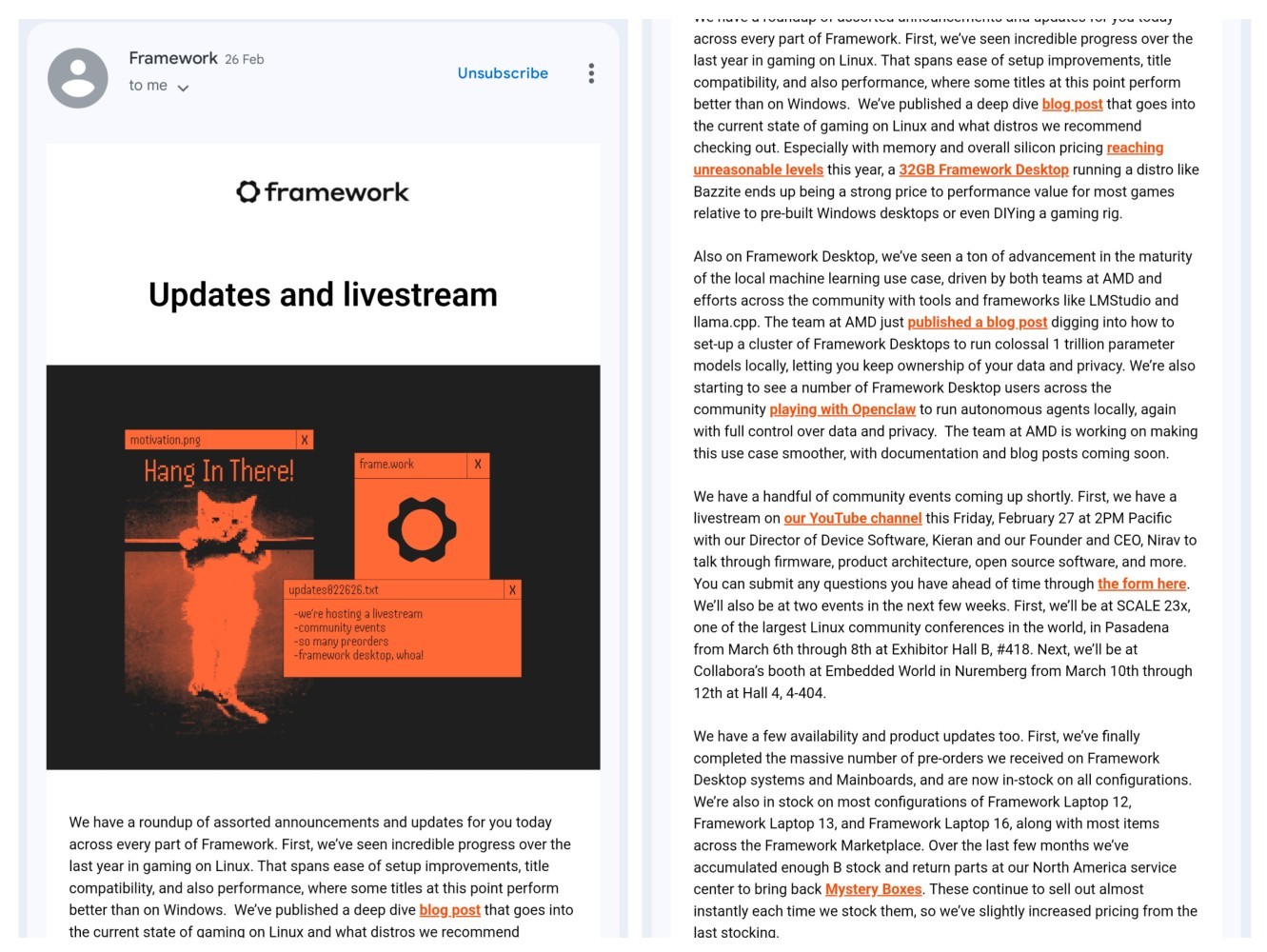
But reading through their emails, I also notice what's missing. Every email is written for someone already deeply invested in the brand. The enthusiasts, the community builders, the people who already own a Framework laptop and are following along. I love reading these, but there's almost nothing aimed at someone still on the fence, still deciding, still needing to be convinced. This is a noticeable gap.
I firmly believe email is a great opportunity for getting information directly to your audience since it isn't controlled by an algorithm like social media, and your audience is more likely to actually encounter what you've sent them compared to a blog post. Important things Framework publishes on their blog and YouTube that they really want their audience to see can be surfaced through email, rather than waiting for the algorithm or hoping their audience stumbles across it later. If I was part of their marketing team here are some things I would do to make use of the opportunity newsletters provide.
First, I'd get serious about the audience
Framework's email list isn't one audience. It's at least four. There are the enthusiasts who've been following since the beginning and want every update and announcement. There are mainstream buyers who found Framework through a YouTube review and are still deciding if it's worth it. There are existing owners who already bought in and now need reasons to stay engaged, upgrade, and advocate. And there are developers and community creators who are building things on top of Framework's open-source hardware.
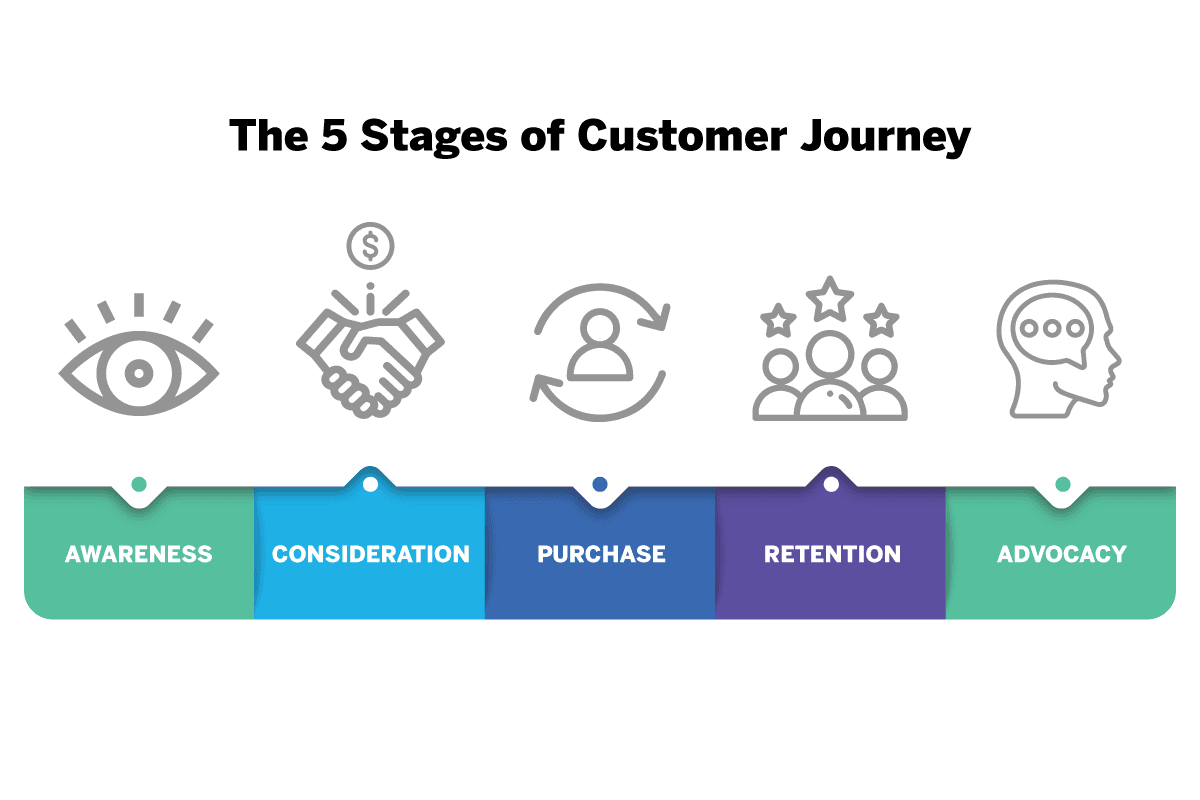
These four groups are at completely different stages of the customer journey, and right now they're all getting the same emails. My approach would be to clearly identify which subscriber falls into which segment and cater to all of them. Some emails can be written in a way that provides value to the whole audience at once, while others can be sent to a specific segment only. The impact of segmentation is significant: according to Mailchimp, segmented campaigns generate 100.95% higher click rates, 14.31% higher open rates, and 9.37% lower unsubscribe rates than non-segmented ones.
According to DMA, marketers have found a 760% increase in email revenue from segmented campaigns. All of this makes sense because a relevant email gets opened, and an irrelevant one gets ignored or unsubscribed from.
To build out proper segmentation, some of the data I'd need comes from the signup process, but a lot of it is already sitting in engagement behaviour. Results of surveys, which Framework already runs, can also feed into this.
Some of my working segments would include: existing device owners, prospects still in research mode, enthusiasts and community followers, developers and creators, and lapsed subscribers past 90 days of inactivity. Each segment gets a different content mix with a different job to do. For owners, I'm focused on lifetime value and turning them into advocates. For prospects, I'm making the case clearly and without pressure. For developers, I'm spotlighting community builds and open-source releases. For the lapsed, I'm leading with something genuinely useful, not a promotional nudge.
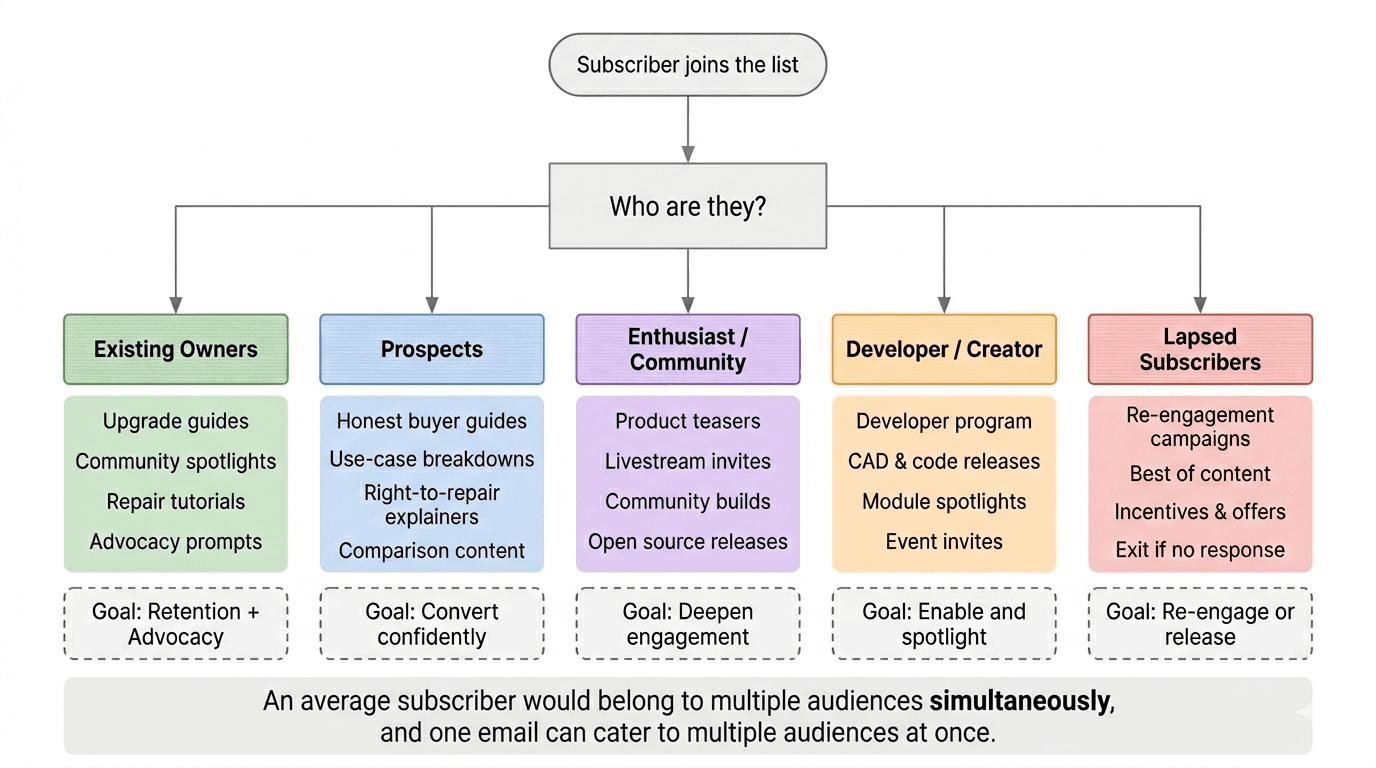
Alongside segmentation, I'd layer in personalization. Not just first names in subject lines, though that works well sometimes. According to McKinsey, 71% of consumers expect companies to deliver personalized interactions, and 76% get frustrated when it doesn't happen. Cleverly implemented personalization is something subscribers would genuinely welcome.
What the emails would actually do
I love a lot of what Framework currently does: they give transparent stock and availability updates across all products, they explain pricing changes honestly with full context on what's driving costs in the industry, they signpost blog posts they've published with a brief mention and a link, they spotlight community projects and open-source builds from the developer ecosystem, and they announce upcoming livestreams and conference appearances. Every email carries a personal founder-led tone that feels genuine rather than corporate.
The content I'd add starts with educational writing on repairability and right-to-repair policy, written in the same plain honest voice their current emails already use. Alongside that, benefit-driven product storytelling rather than spec-first announcements. Framework's emails are good at telling you what a product does. I'd push harder on who it's for and why it matters to that specific person. The developer who needs privacy for local AI inference on a Framework Desktop. The student who can't afford a new laptop every three years. The gamer who wants more performance without compromise.
Community spotlights sent specifically to owners and enthusiasts. Framework's audience responds to seeing the hardware used creatively, modded, rebuilt, and pushed beyond its original purpose. That demand is already visible in how people engage with the brand publicly. An occasional spotlight email featuring who built something, what they used, what problem they solved, and where to find the files would give this content the depth and permanence a newsletter can provide that a social post can't.
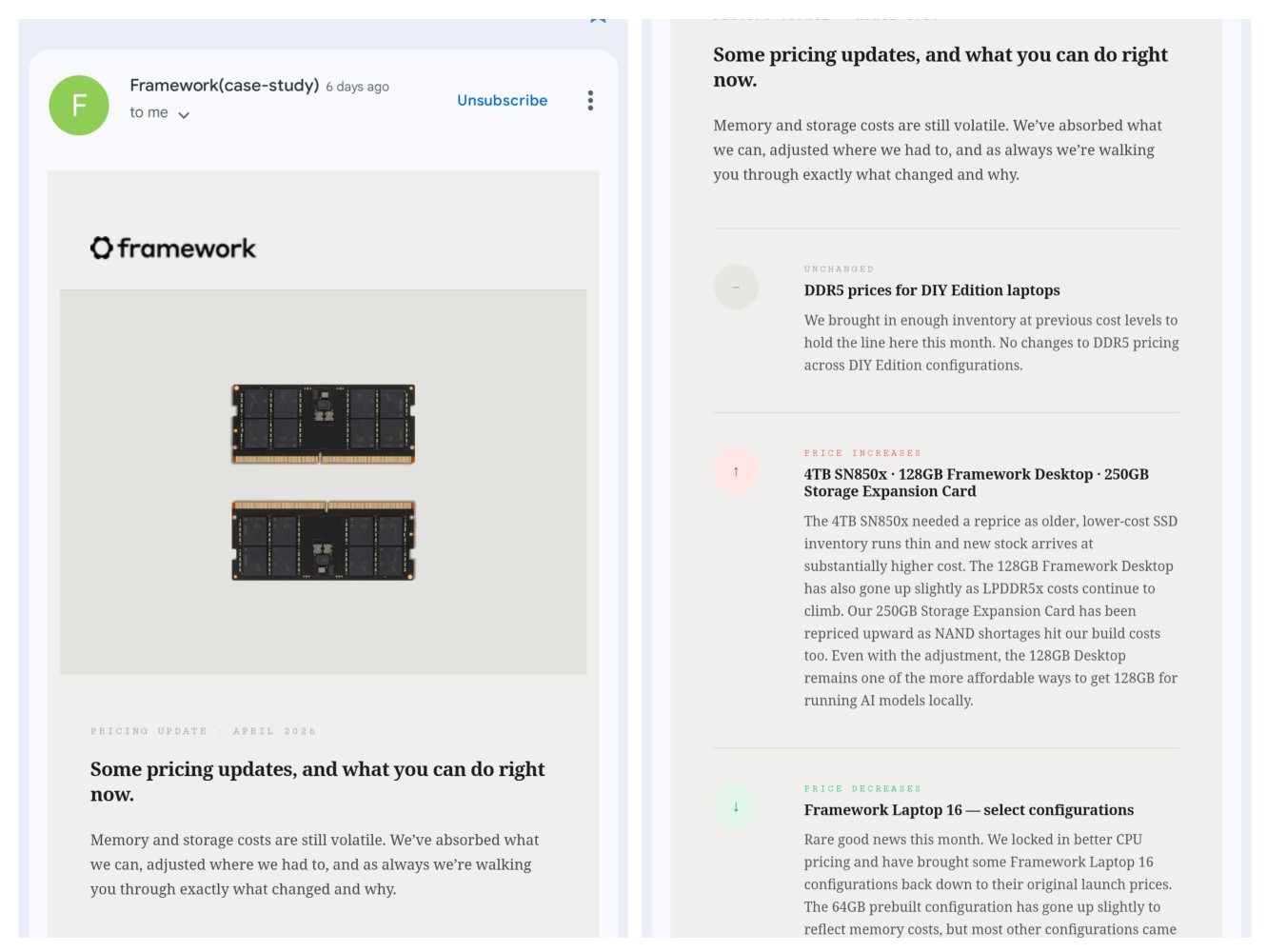
I'd also expand on cross-channel reinforcement so the newsletter doesn't exist in isolation. If key information like a pricing update is going live, newsletter subscribers should hear about it at the same time, with the key details and a link to learn more on the blog. The email should feel like the most informed place to be, not a digest of things that already happened elsewhere.
Below is an example of turning a blog post with critical pricing information into an email sent directly to subscribers, so they're in the loop immediately rather than waiting for the algorithm or stumbling across it weeks later. View the full mock up email here: https://archive.sendpul.se/u/OTMzMDQ0MA==/a4kg/
Keeping the Framework DNA intact
One thing I'd be careful not to do is redesign the email experience in a way that stops feeling like Framework. Their current emails are clean and minimal. No aggressive CTAs, no countdown timers, no overly promotional layouts. That spareness is a design choice and it signals something about the brand: we're not trying to manipulate you into clicking.
The benchmark I'd point to are the best examples of consumer hardware brands that treat every email as an extension of the product experience rather than a marketing vehicle. Framework's brand has a natural affinity with that approach. Where I'd adapt it is in three areas: subject lines that create curiosity first and allows the preheader do the explaining; a focused structure for product emails that forces specificity rather than defaulting to long paragraphs; and a one-idea-per-email rule for some content sends, reserving the roundup format for a monthly email where it makes more sense.
I would also avoid high promotional frequency. Sending sales emails constantly, seasonal offers, holiday discounts, that cadence works for brands chasing broad volume. It would undermine everything that makes Framework's brand trustworthy. Framework's emails should stay offer-light and earn their place in the inbox through genuine value, not urgency tactics.
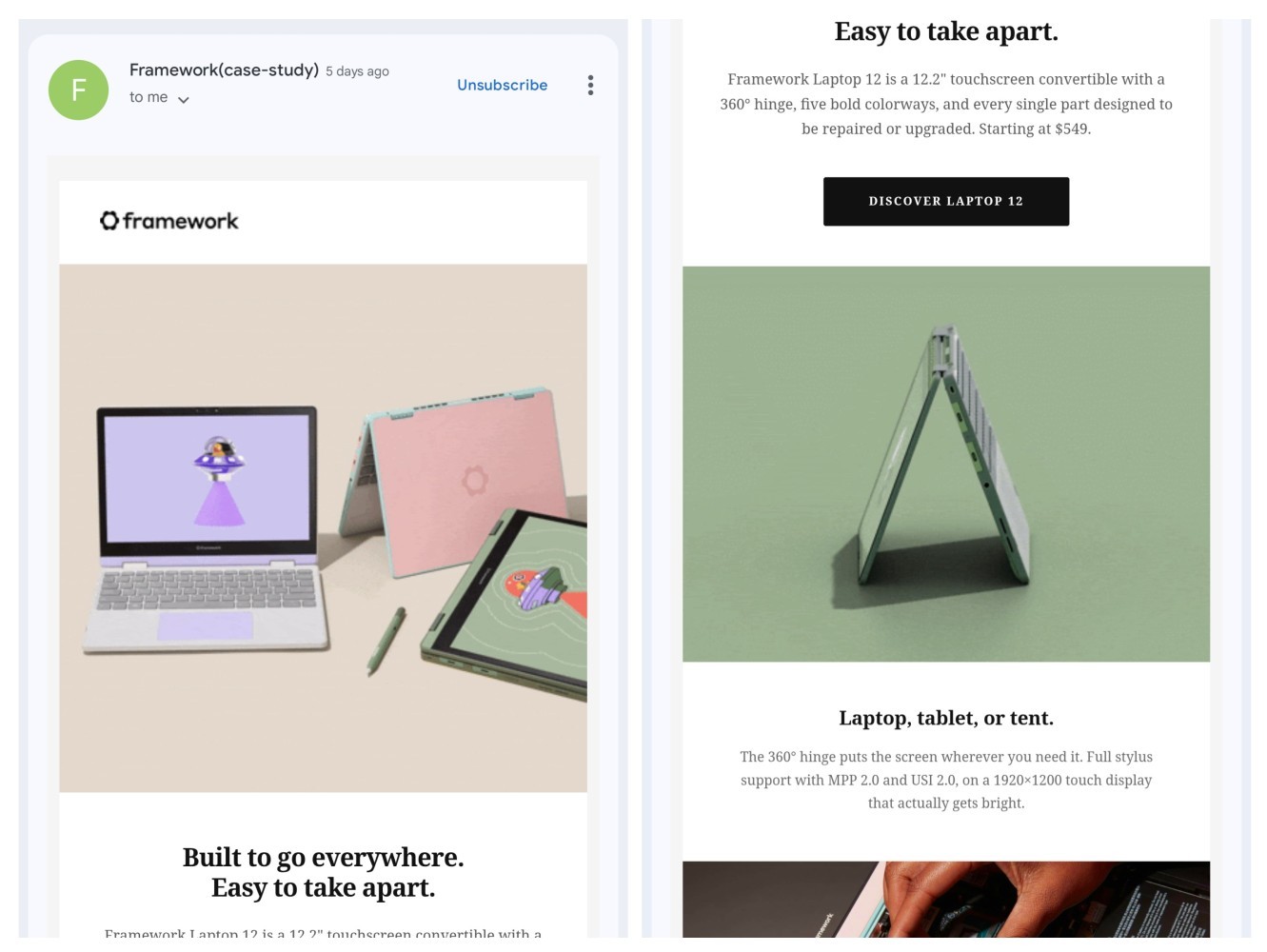
Something email can also do is carry the unique product identity Framework establishes on its website into the inbox. Each product on frame.work has its own visual language and personality, and that identity can be translated into product-focused emails. I designed an email for the Laptop 12 as an example of how that identity can be carried into email, adding clean visuals like looped videos and images. View the full mock up email with the animations here: https://archive.sendpul.se/u/OTMzMDQ0MA==/a5p
Finding the Right Send Frequency
Framework sends a few times a month, most often once, and it leaves moments on the table. A right-to-repair news win. A timely repair tutorial timed to a product release. Content that would have landed perfectly that week instead of waiting until the next roundup.
I'd target a steady average of one email per week, which is still a few times a month, with flexibility to pull back when there's genuinely nothing valuable to say. For Framework, that's almost never the case. Cadence would also vary by segment: enthusiasts and developers might welcome more frequent touchpoints, while prospects need a slower, more deliberate sequence that builds confidence without overwhelming them before they've made a first decision.
Building the list the right way
Framework already does this well. The newsletter signup is on the website without being overly pushed as a marketing tactic. There was recently a RAM giveaway that included a newsletter signup option, which is exactly the kind of value-first list building that works because people opt in because they actually want to. I'd build on that approach, making sure every signup entry point is clear about what subscribers are actually getting: not just product announcements, but genuinely useful content about getting more from their devices and understanding the industry they're buying into.
On the maintenance side, I'd run regular re-engagement sequences for inactive subscribers and remove those who don't respond. A smaller, engaged list is more valuable than a bloated one with low open rates, and it keeps deliverability healthy so the emails that matter actually land.
The welcome email Framework sends right now opens with their mission statement and closes with a personal sign-off from Nirav Patel and the team. My job would be to build on that and expand what's already working into a more deliberate, segmented experience that meets every type of subscriber where they actually are.
Email as the Long Game
At 12 months, I'd want a list that's smaller than it could be if I chased vanity metrics, but significantly more engaged. Owners who feel like they're part of a movement, not just customers. Prospects who arrive at a purchase decision confidently, without having been pushed there. An unsubscribe rate that stays low not because emails are infrequent, but because they're consistently worth opening. If someone stays subscribed and active for a year without buying anything but keeps engaging, that's not a failure. That's a warm relationship waiting for the right moment.
Framework isn't just selling laptops. They're making an argument that the consumer electronics industry has been doing things wrong for decades: building products designed to become obsolete, making repair deliberately difficult, treating customers as revenue streams rather than people. The right-to-repair movement has been making this case in courtrooms and legislatures for years. Framework is making it in product design and in how they show up publicly every day.
Email is where that argument can be made most directly and most personally. A newsletter that educates subscribers on their rights as consumers and treats the inbox as a space for real conversation rather than conversion is a serious marketing asset. Framework really is something rare, a brand consistently showing up on the right side of an important conversation. Done well, this email marketing approach would support Framework's marketing goals and help get the right message to the right person at the right time, every time.
Read on LinkedIn